
I-Spy
INTRO
With the advancement of image capturing technology, there has been a rise in individuals’ private moments being collected without consent. Our project aims to support young travelers to feel confident in their privacy throughout the travel process and to empower them to act decisively in the event their privacy is violated.
This project was created as a class project (HCDE 518).
DISCIPLINE
User Research
User-Centered Design
TEAM
Janny Gao
Ruohan Li
Lina Wang
YEAR
2025 (ongoing)
01Project Overview
With the advancement of image capturing technology, there has been a rise in individuals’ private moments being collected without consent. Particularly in private spaces such as public restroom stalls, changing rooms, hotels, and homestays, there have been various privacy violations where individuals have been recorded without consent. Our project aims to empower individuals to protect their privacy and keep their intimate moments for themselves.
02Beginning Design Question
How might we help individuals protect their private moments from being collected without consent?





03User Research Methods
Our project began with an extremely broad scope. After conducting desk research, as a team we decided to hone in on a specific area where individuals experience privacy issues: in homestays and hotels when traveling.
We decided to make use of multiple research methods to triangulate and mitigate research limitations. Our main methods were the following:

Secondary Research
21+ news reports and academic journals

Surveys
12+ responses

Ethnographic Studies (Netnography)
4+ first-hand accounts

Interviews
6 semi-structured
Early Research Questions:
When and where do people consider themselves to be ‘in private’?
What do people consider to be a violation of privacy?
What type of surveillance technology is often used covertly in private spaces?
What private spaces tend to have hidden surveillance?
Who are the main victims of covert surveillance attempts?
01 — Secondary Research
This research helped us contextualize our design problem within global trends in surveillance and emerging technologies to gain a more holistic view of people’s attitudes and actions toward surveillance. We conducted a literature review, deep diving into 21 published news reports and academic journals.
Our review covered topics about surveillance technologies, persons’ attitudes towards private and public spaces, and surveillance consent — including reports of privacy invasion through surveillance and laws on surveillance across different levels (national, state, and company).
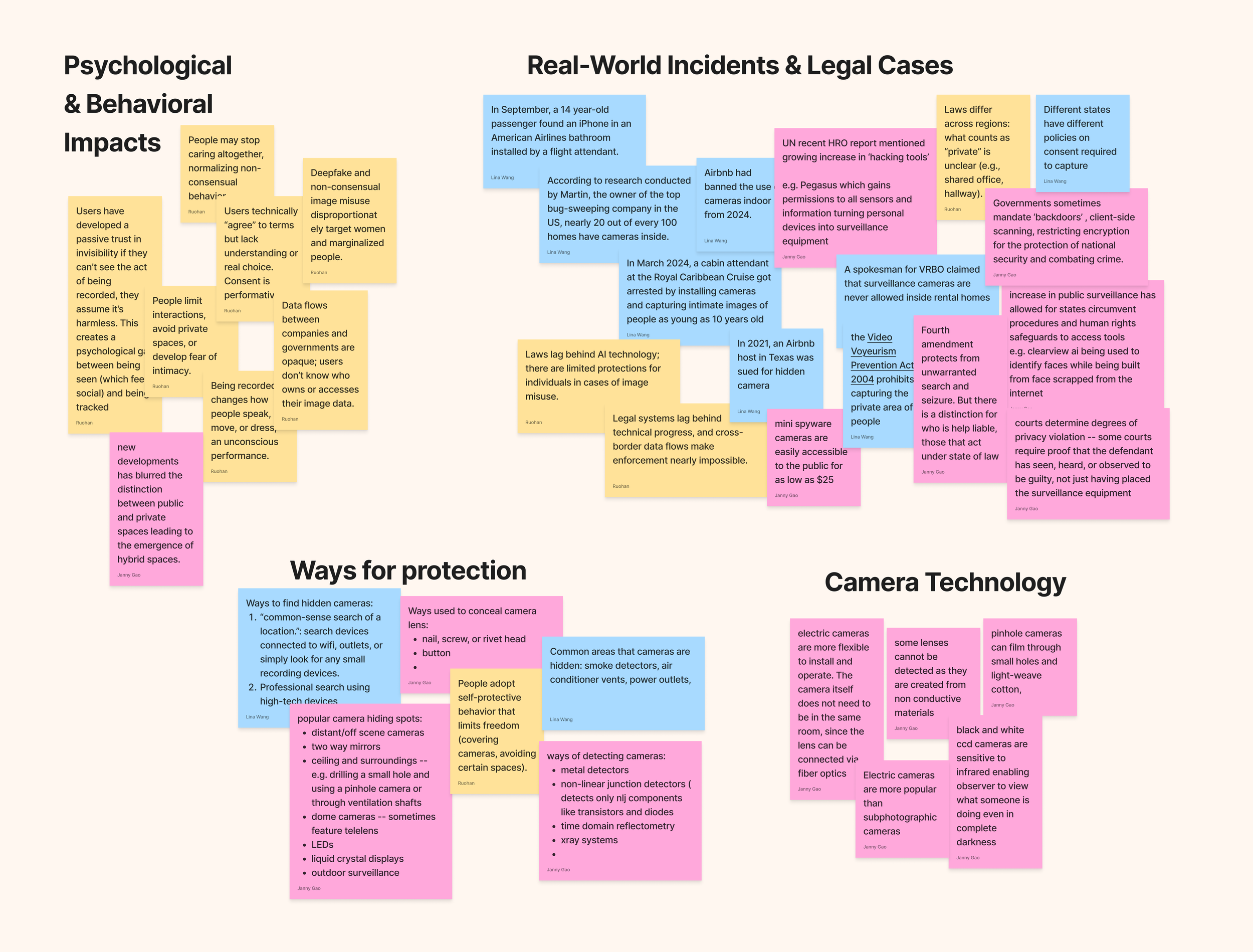
We summarized our findings and compiled them into an affinity diagram, which organized our insights into five main themes: privacy invasion through hidden cameras, detection methods for hidden cameras, legal implications and protections, technology's impact on privacy, and psychological and behavioral impacts.
Initial Insights
Privacy laws vary, lagging behind technology and covert surveillance is common.
People assume privacy only when monitoring isn’t visible.
Blurred lines between private and public spaces has led to two outcomes: (1) either users stop caring altogether about being observed, creating a psychological gap between being ‘seen’ versus being ‘tracked’ or (2) people limit their interactions and avoid private spaces, developing a fear of intimacy
people move, act, and perform differently under surveillance
02 — Surveys
With limited time, we conducted a survey to better understand individuals’ relationships with surveillance and their boundaries in terms of private spaces. We structured it to gather basic demographic information before asking respondents to answer on a scale their privacy expectations in different spaces. We also included various statements and evaluated how much the respondents resonated with them. Our survey did contain an optional section with less structure where the users could expand upon their personal experience(s) with hidden surveillance. The survey was structured with mostly scale-based evaluations or multiple choice questions to reduce burden during completion. The vast majority of our respondents were between ages 18 to 34 in range.
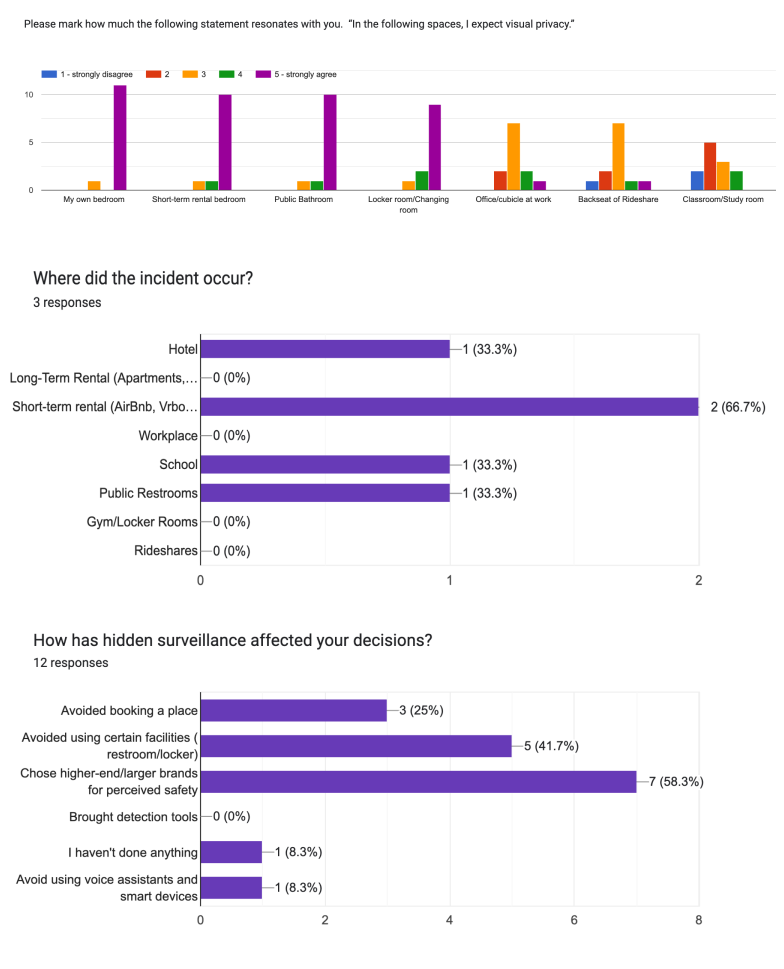
Findings
Discovery rates: 20% have discovered hidden surveillance in hotels
Privacy expectations: People expect strong audio and visual privacy in bedrooms, bathrooms, locker rooms, and offices
Psychological impact: Surveillance makes spaces feel public
Current precautions: Detection behaviors are uneven—some users reported that they unplug smart devices, read reviews, or ask about surveillance policies, but people rarely scan rooms or use detection tools
Detection confidence: Overall confidence in detecting surveillance is moderate
03 — Ethnographic Studies (Netnography)
Due to the limiting factors for field research, we collected data from online social media platforms. From a popular East Asian social media platform 小红书 (XiaoHongShu), also known as RedNote, we found 3 personal first-hand accounts and 1 summarized repost, since the original content was deleted, regarding hidden cameras discovered in their homestay or Airbnbs at different destinations around the globe. Additionally, we found other users' discussion posts regarding their personal feelings about hidden surveillance. From the various posts, comments, and the discussions of the platform’s community, we were able to gather insights about people’s experiences, fears, and overall attitudes towards surveillance privacy violations.
Findings:
Visible but undisclosed surveillance still evokes strong discomfort, especially when used to monitor or control guests.
Visibility of the surveillance (i.e., the unknown nature of who is watching and how) creates lasting emotional distress, not just momentary discomfort,— heightening the sense of loss of agency
Guests assume transparency and trust when the listing claims “no monitoring devices,” and the absence of disclosure breaches that trust. Power imbalance between hosts and travelers intensifies fear and helplessness.
Lack of clear, enforceable reporting mechanisms causes users to feel unsupported and vulnerable.
Once discovered, hidden cameras lead to emotional distress, embarrassment, confusion, and uncertainty about what actions to take.
Cultural and legal variations complicate travelers’ sense of safety abroad..
Incidents illustrated how non-consensual image collection transitions from “being watched” to “being exploited.”
04 — User Interviews
Our team conducted 6 semi-structured qualitative interviews to understand people’s behaviors and motivations in more depth regarding privacy during travel. Expanding on our general understanding of people’s privacy expectations from the user surveys.
To gather our interviewees, we used snowball recruiting. We narrowed down our scope to young travelers and restricted our scenario to traveling to new cities. We focused on questions that ask for users’ booking behaviors, their feelings towards surveillance, and what they would do when first entering a rental bedroom. We also delved deep into young travelers’ preferences towards products and services that help them identify hidden surveillance.
Our interviewees were young students or working professionals in their 20s.
Findings:
Hotels preferred for accountability: 5/6 choose hotels over Airbnb for predictable safety standards and clear escalation paths when issues arise.
Privacy expectations vary by space: Cameras in public hotel areas are accepted as security measures, but any surveillance in private spaces (especially bedrooms/bathrooms) is seen as invasive and potentially illegal.
Reactive, not proactive behavior: Most users don't actively sweep for hidden devices on arrival—they rely on brand reputation and visible cleanliness rather than systematic checks.
Detection + guidance is the core need: When hidden devices are found, users want reliable detection tools paired with clear escalation protocols (who to contact, how to document, what legal protections exist). Optional incident logging and reporting features should be user-controlled and privacy-respecting.
Trust requires transparency: Adoption depends on understanding how detection works, social proof from trusted sources, and defaults that respect user privacy (opt-in data sharing, no automatic recording).
04Research Insight Summary
After triangulating and compiling our findings, we were able to organize our insights into the following 3 categories: Surveillance Reality, Privacy Expectations, User Behavior & Preferences
01 Surveillance Reality
Varying privacy laws leave travelers uncertain about their rights, while hidden cameras and accessible spyware make surveillance increasingly common. Being recorded alters behavior and fosters “passive trust in invisibility”, where people assume privacy only when no evidence of monitoring is visible.
From secondary research, we learned that laws differ across regions and what counts as “private” is unclear.
36.4% of survey respondents have found or highly suspect hidden surveillance in spaces they considered private.
Surveillance equipment fundamentally transforms how a space is perceived. Most respondents agree that "having surveillance equipment present makes a space feel public."
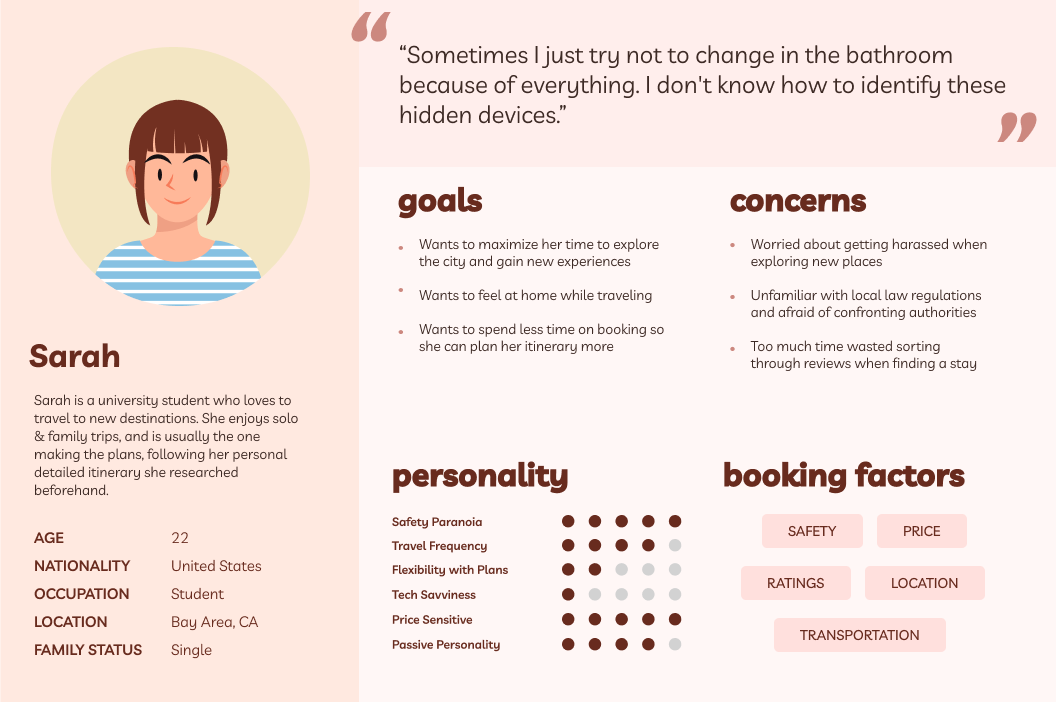
One of the interviewees mentioned that being concerned about having hidden cameras in hotel rooms has limited her ability to change in the bathroom.
02 Privacy Expectations
Cameras in public hotel spaces (lobbies, hallways) are accepted as legitimate security measures. However, any surveillance in bedrooms and bathrooms is seen as invasive.
All six interviewees explicitly or implicitly accept cameras in public/common areas as deterrents or legitimate security.
“Public spaces like transit, stores/malls—surveillance acts as a deterrent.”
“Helps catch and document crimes/accidents.”
5 out of 6 interviewees said they would immediately vacate their stay upon discovering hidden surveillance.
Survey respondents said they expect very strong visual (91.6%) and audio (83.3) privacy in their bedroom.
03 User Behavior & Preferences
Travelers typically book accommodations based on the “Four C’s”: Convenience, Cleanliness, Crowd-proofing, and Consensus—focusing on location, hygiene, safety cues, and customer reviews. Most rely on trust built through online feedback and visible upkeep rather than actively checking for surveillance devices. While they care about privacy, travelers prefer low-effort, time-efficient solutions that ensure safety without disrupting their travel routines.
5 out of 6 interviewees prefer hotels over Airbnb for predictable safety standards, staffed resolution processes, and clearer escalation paths when issues arise.
Most interviewees (4 of 6) perform quick visual checks for cleanliness and obvious issues upon arrival, while the remaining third rely entirely on brand reputation and pre-booking research—notably, none conduct technical sweeps for hidden devices.
Nearly all interviewees prefer either a small portable device or technology built into their phone (e.g. apps) for preventative/responsive solutions when traveling.
5 out of 6 interviewees provided an acceptable one-time purchase price. One interviewee explicitly rejected subscription plans.
Two of the interviewees mentioned that they haven’t felt strongly enough about current detection products on the market to purchase.
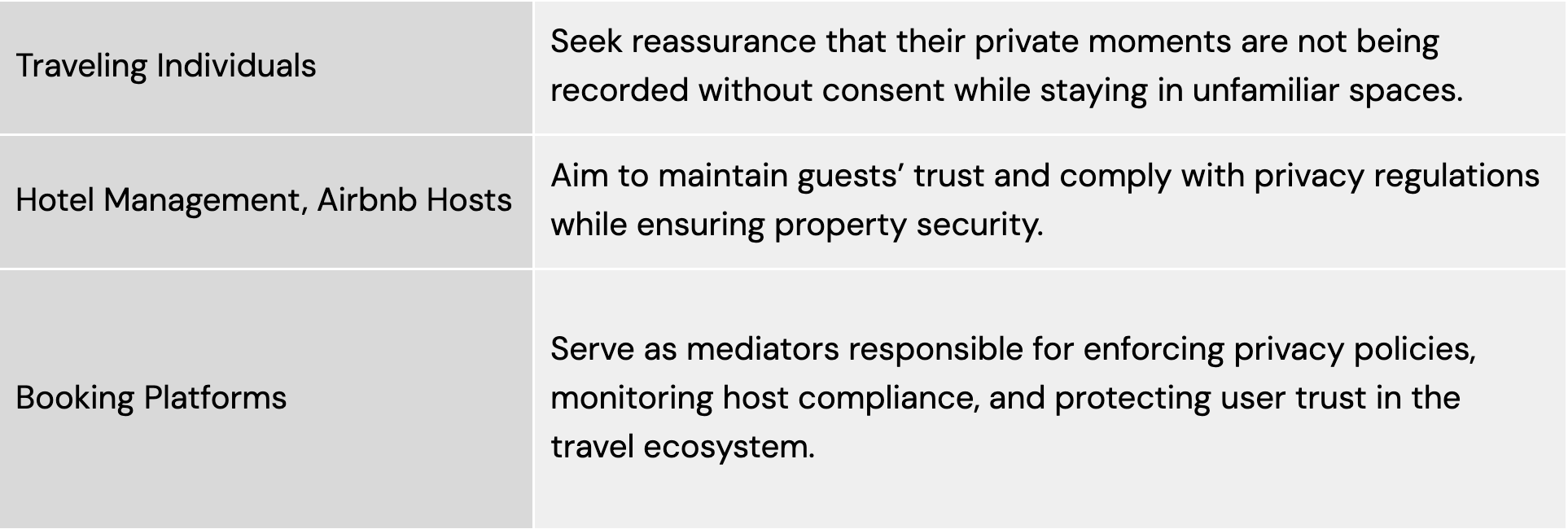
Identifying Stakeholders and their Goals
User Design Requirements
Portable size: The device must fit in carry-on luggage or a jacket pocket. It should be no larger than a TV remote. If the design is app-based, it should work with users’ existing smartphones without bulky accessories.
Ease of use: The tool should provide immediate and clear results without requiring technical knowledge.
Transparent detection methodology: The design should allow users to understand its underlying mechanism and technology easily. It should also communicate its capabilities and limitations clearly.
Users are in control: Users choose when to log incidents, save evidence, and report findings. Escalation requires explicit consent at every step. Users can delete all data anytime.
Reactive over proactive: The tool should fit naturally into users’ existing arrival routines rather than demanding investigative behavior.
Personalization: The tool should be able to adapt to different traveler needs and risk tolerances. The system should remember preferences across trips.
Social proof drives adoption: Friends’ usage and high ratings matter more than marketing claims.
05How might we help young travelers in their 20s feel confident in their privacy throughout the travel process (before, during, after their stay) to empower them to act decisively if their privacy is violated?
05Refined Design Question
Our survey and interviews revealed that travelers often feel anxious about their privacy as early as the booking stage, worrying about hidden cameras or data misuse. This indicated a need for solutions that provide reassurance proactively, not just reactively. We also found that young travelers value emotional comfort and confidence more than purely technical detection—they want to feel safe, informed, and in control throughout their experience. Additionally, many participants expressed uncertainty about what actions to take if their privacy is compromised, highlighting an opportunity for empowerment and clear guidance. By reframing our question, we shifted our focus from simply “preventing surveillance” to holistically supporting travelers’ sense of safety, trust, and agency across their entire journey.
06
Personas
From our data, we decided to prioritize two types of individuals whose specific needs best reflect the majority. While there are many other types of travelers—frequent or infrequent, experienced or novice, luxury or budgeting, holiday or business, careful planners or spontaneous open-minded adventurers, solo or family/group—we decided to hone in on the cautious nervous-planner and the opposing laid-back optimistic traveler to stay aligned to our design question: “How we can help young travelers feel secure in their privacy?”.
While these two traits were our primary focus when building the user personas, we integrated other travelers' traits and behaviors to create two distinct composite traveler archetypes that represent our target users. These personas reflect our research goals and findings and can help us stay aligned during the ideation phase.
Persona 1: The Cautious Traveler
The cautious traveler travels frequently, is experienced with travel routines, plans, and bookings, and they take more precautions toward their personal safety and privacy. The cautious traveler invests a significant amount of time researching and planning the details of their trip, paying more attention to brand reputation and carefully sorting through reviews when considering their booking choices. When visiting a new destination, they carefully investigate all the details of their trip and organize an itinerary, ensuring a well-planned trip with no surprises.
Persona 2: The Trusting Optimist
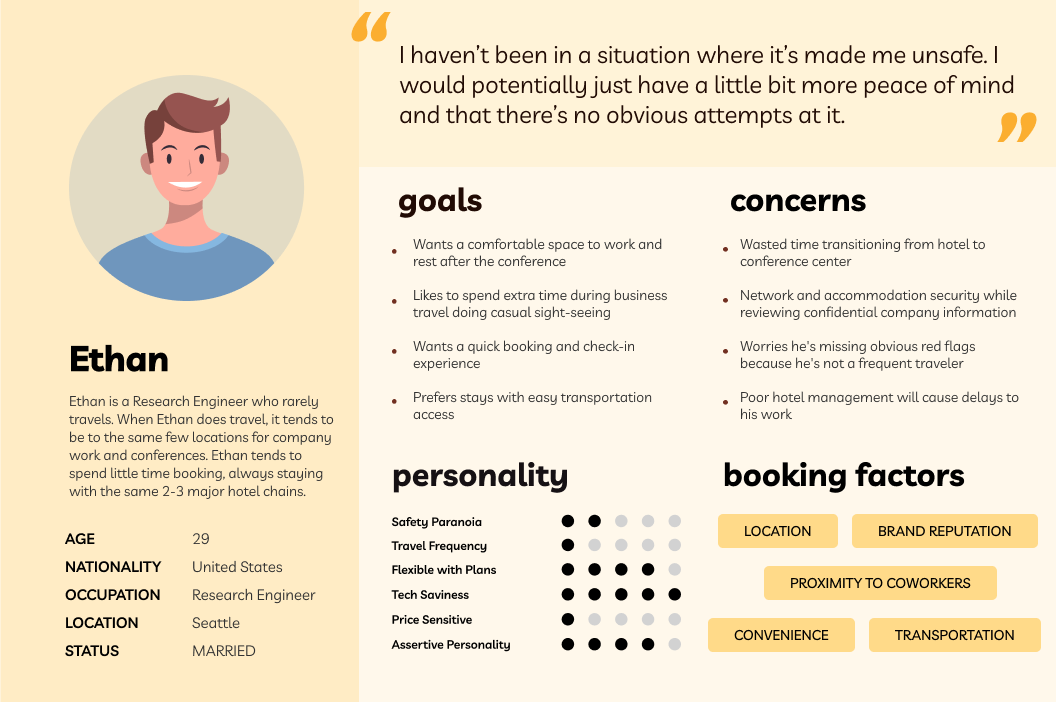
The trusting optimist tends not to sweat the details and waste time on planning, believing that they can figure it out as they go and that the trip will work out in the end. They tend to go with the flow, prioritizing the booking convenience and location proximity to transport over the potential risks of safety and privacy during their stay.
07Brainstorming/Ideation (current)
We are currently in this phase of the project. Having gathered our research insights, we have organized them into a few user design requirements. Additionally we have done our first round of initial sketches. Feel free to take a look!
‘How Might We’ Brainstorming Session
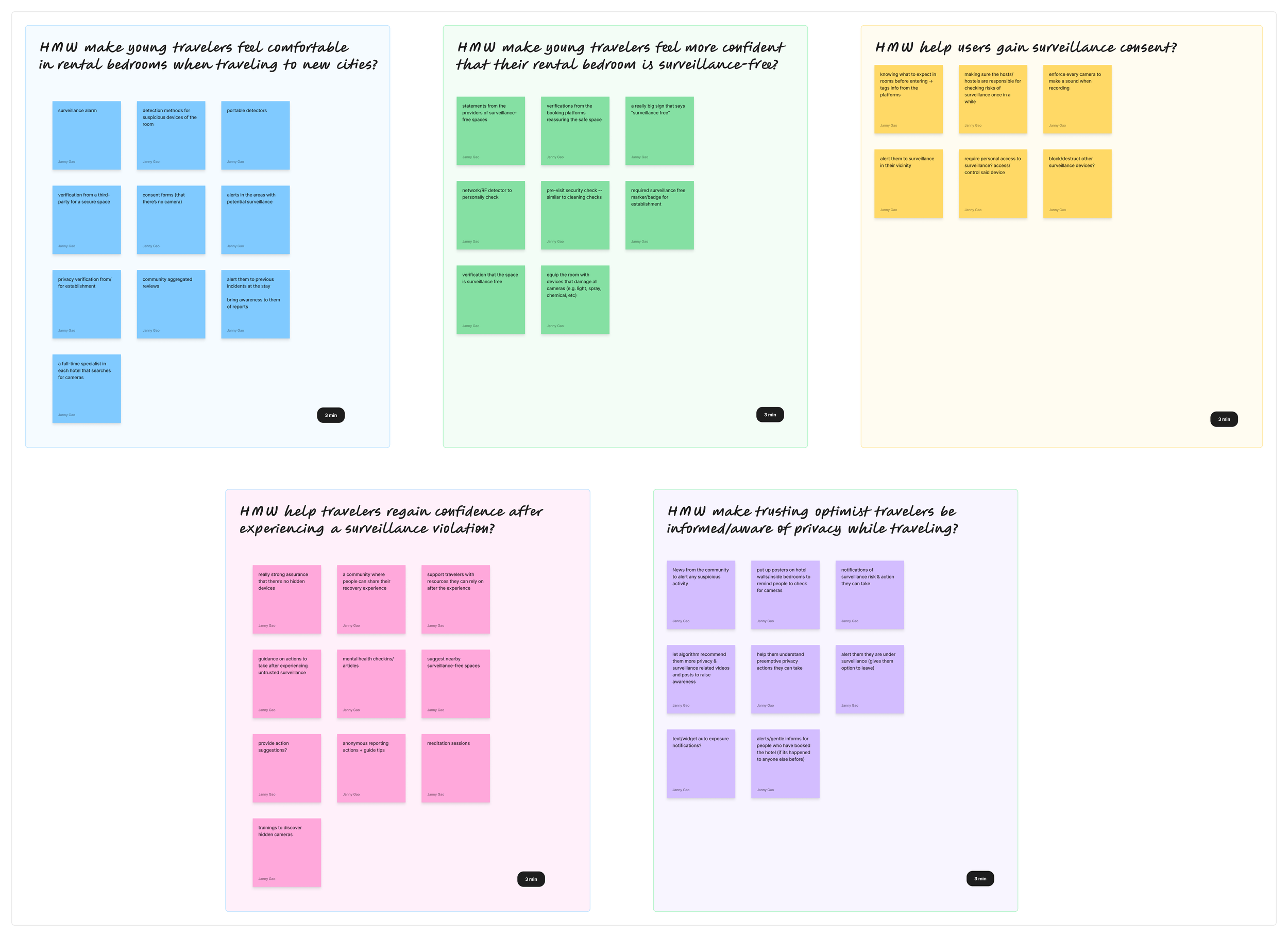
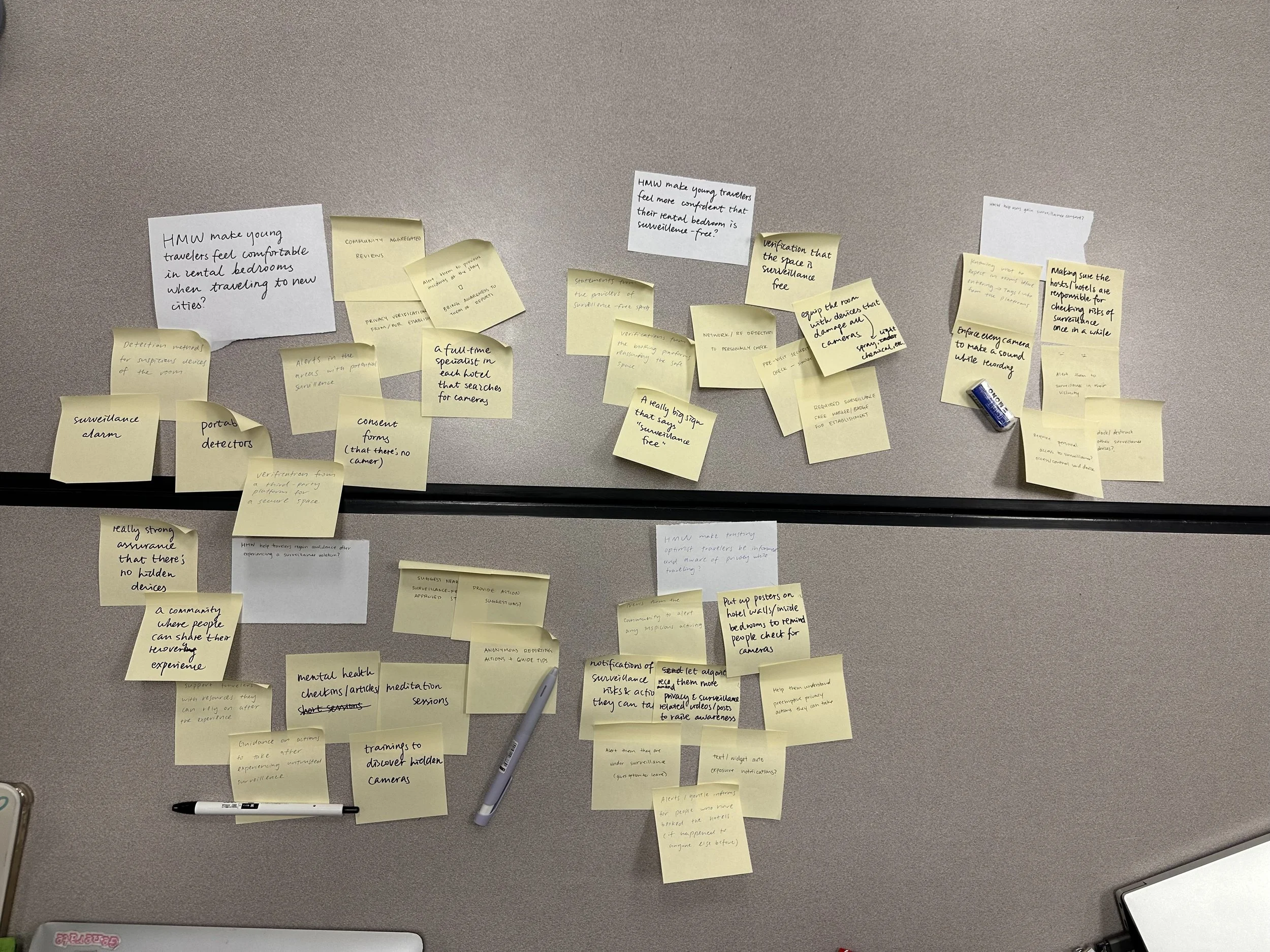
We completed a quick “How Might We” brainstorming session to focus our insights and try to understand what we specifically needed to target to help our users. After identifying 5 different questions, we brainstormed some possible solutions. Here’s a look at our brainstorm map:

Sketch Ideation
Following our HMW brainstorming session, we conducted a quick iterative sketching session. After we finished our 18 sketches, we sorted ideas by strengths, weaknesses, and feasibility.
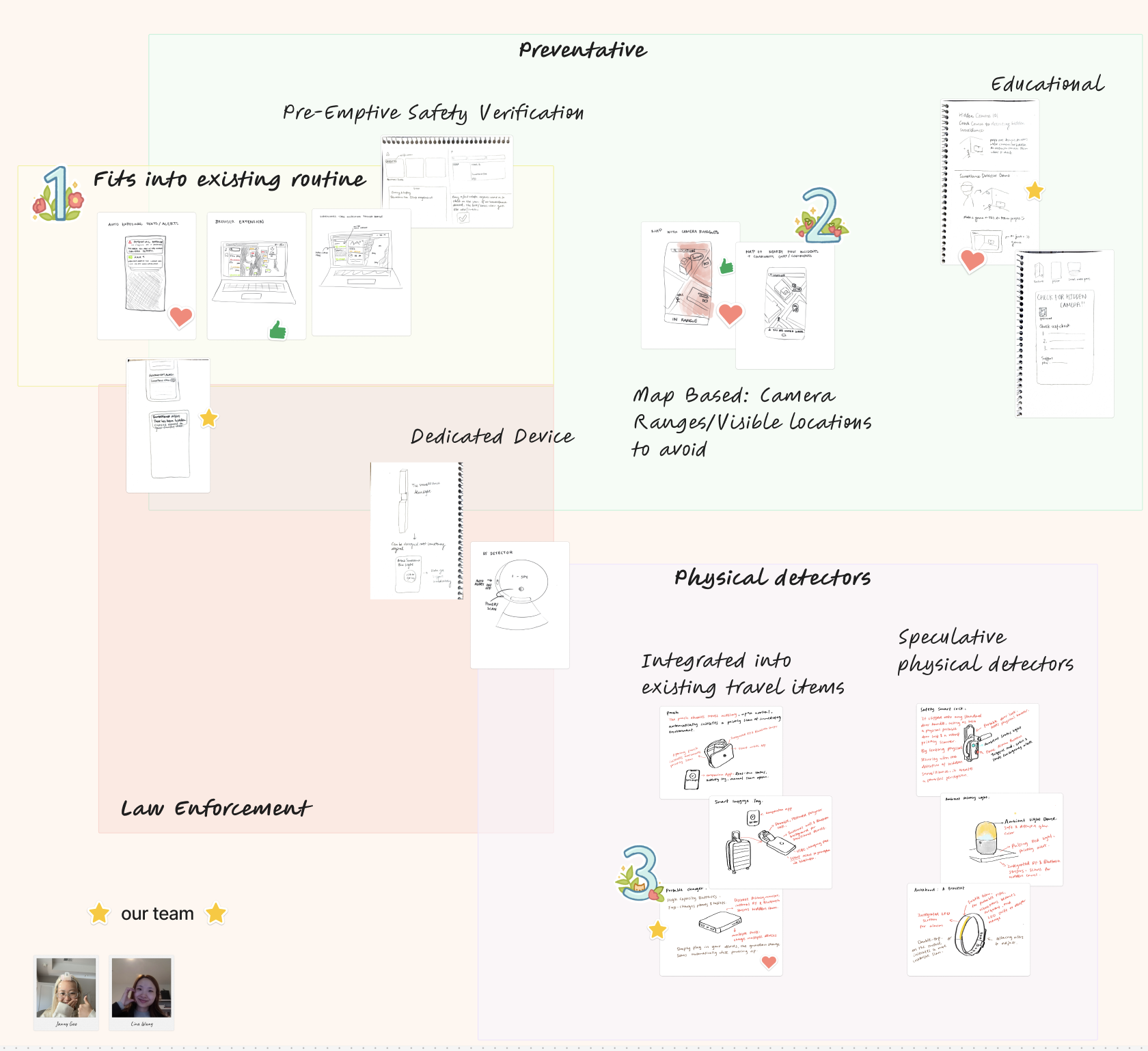
Where we are now
Currently, we are refining sketches and exploring our ideas! Please contact me at jannygao@uw.edu if you would like to learn more.